Asia Investment Advisors
  • Home
  • Profile
  • Investment Blog
  • Events and Press
    • Events
    • Press Articles
    • Media Quotes
  • Contact
  • Disclaimer

Pain and pleasure in China property bonds

10/11/2014

0 Comments

 
This is the reproduction of an article in IFR Asia.
To many global investors, bonds from China’s property sector are toxic nuclear waste, not to be touched at any cost. To others, they come with a more pragmatic “handle with care” warning. I belong to the latter camp.

From just a handful of bonds 10 years ago, the sector has grown to contribute 9.5% of the Asian US dollar bond market with US$51bn of bonds trading. That is nearly a third of all high-yield corporate bonds in the region.

Over this period, the sector has gone through three cycles of downturns and upturns. Several Chinese property companies have issued, redeemed and refinanced their offshore bonds. Companies with credit ratings ranging from Single A to Triple C have managed to issue bonds, which trade actively in the secondary market. Yet, a feeling of unease persists.

Perhaps the first source of discomfort is the fact that offshore Chinese property bonds are deeply subordinated, since they are issued by offshore-incorporated entities, which inject the bond proceeds as equity into their onshore companies and service their debt only out of equity dividends received back from the mainland. The difficulties in repatriating equity funds out of China mean that the offshore principal effectively has to be refinanced. In case of bankruptcy, the onshore lenders have the first claim over the onshore assets.

While this structural weakness is undoubtedly true, it applies to every other bond issued by Chinese businesses, including investment-grade bonds far beyond the property sector, since the structure was born out of regulations prohibiting the issuance of debt or guarantees by mainland companies. (Only recently have the authorities begun to relax this prohibition, and the first few offshore bonds are now coming out with direct guarantees from mainland operating companies.)

ANOTHER SOURCE OF discomfort is the government’s meddling in the property sector through various measures, including the flow of credit to the builders, rules for financing land purchases, obtaining mortgages, and mortgage down-payment requirements. The harshest controls came in 2010 when the government restricted the number of apartments that an individual could purchase.

Property prices are a sensitive subject everywhere, and China is no exception. The government presses the brakes if the prices are speeding too fast and pushes the accelerator if property construction flags too much so as to threaten the overall economic growth.

This government intervention makes asset values volatile in both equity and debt markets, and raises the cost of capital to the sector.

Some investors have also been scared away by stories of oversupply and ghost cities. The property development business model, by definition, consists of a long operating cycle, and there may be genuine demand/supply imbalances, as in any other industry, but the overwhelming majority of Chinese properties are built in response to actual demand from a rapidly urbanising population. The same goes for talk of speculative buying, when the reality is that most of the properties are bought for self-occupation. Buyers have to put up a minimum 30% down-payment, they are not over-leveraged and there is no subprime lending.

WHEN IT COMES to investing in Chinese property bonds, one should realise that there has already been one level of filtering – only those companies large enough to go through a rating process and the expense of issuing offshore actually end up selling dollar bonds. They are all listed offshore, most of them in Hong Kong, and are subject to audits and disclosures that go with the listing status. The additional scrutiny from equity analysts and investors that comes with listing also offers additional information for bond investors.

There has not been a single default in the sector so far, and only two distressed exchanges in 2009, both at 80 cents to the dollar. Some companies did go through financial distress during previous sector downturns, but they managed to sell land or unfinished projects to stronger players and stave off default.

This is not to argue that we would never see a default in the sector. We will, sooner or later. But the sector has genuine fundamentals, strong and weak players, and saleable assets that can be realised in times of distress.

So, how should one approach investments in Chinese property bonds? First of all, investors need to be prepared for the volatility that comes with the regulatory changes. Any crash in value following a regulatory tightening offers an opportunity to pick up the higher-quality bonds at more attractive prices. In fact, such moves also enable the stronger players to buy out the weaker ones or to acquire assets from the struggling players, and increase their market share.

The current downturn in the market is no different. It is true that the stock of unsold property is running above average; that the leverage has increased in the last 12-18 months in response to slowing sales; that margins are under pressure due to the pressure to liquidate stock; and that some of the weaker companies are likely to experience a liquidity crunch in the next 12-18 months, unless they slow down their expansion. But the current downturn is also an opportunity to pick up bonds issued by stronger companies, which will benefit from the tight conditions in the sector. The challenge is reading the credit fundamentals carefully enough to identify the winners.
0 Comments

Is there a bubble in Asian fixed income?

9/30/2014

0 Comments

 
Asian bonds have had a good run so far this year, producing a total return of 7.8% according to J.P. Morgan Asia Credit Index (JACI). But, looking back over the last three years, yields and spreads have steadily declined, so much so that “high yield” has become an oxymoron!

That has raised the question in the minds of many people: Is there a bubble in Asian fixed income?

The “B” word has been applied variously to different asset markets, such that it has become an amorphous thing … one that everyone talks about all the time, but no one knows precisely what it means!  Let us try to keep the dreaded word in perspective for our discussion. One definition of a bubble is when the prices are far in excess of the fundamental value of the assets. Another way to look at a bubble is as an unsustainable and fast rise in prices. Either way, a bubble carries the potential to hurt investors when it eventually suddenly bursts.

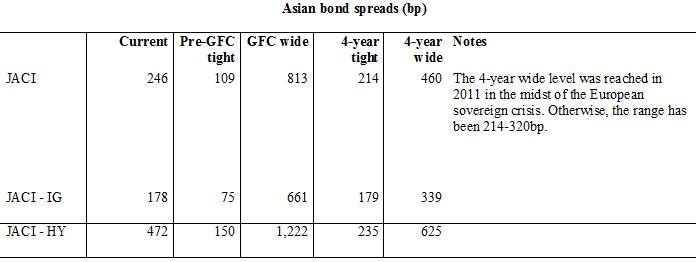
Keeping this in mind, let us examine the evidence in the Asian U.S. Dollar bond markets. The first evidence for the existence of a bubble is the contraction in both yields and spreads. It is true that the current yield to maturity of 4.6% for JACI seems too tight, particularly when compared with the high level of 11% during the Global Financial Crisis. But if we disregard the spike in yields during the GFC and the period when the interest rates were slashed in its aftermath, average yields have moved in a narrower range of 4.2% to 5.5% in the last four years and the current yield is near the middle of this range.

Similarly, if we consider the history of spreads, the current spreads over Treasury of 243bp appears tight when compared with the GFC high of over 800bp. But in the last four years, they have ranged between 214bp and 450bp; and if we disregard the mini-spike during the European sovereign crisis, they have moved between 214bp and 320bp. Compared to this range, the current spreads do not appear so alarming. In fact, they are more than double the tight levels of 109bp reached in 2007 before the GFC.
This is the reproduction of an article in IFR Asia.
Picture
Compared to the U.S. domestic bonds, Asian spreads still offer value. Asian investment-grade corporate bonds, for example, trade at 180bp over Treasury, while spreads for U.S. industrial bonds with equivalent credit quality and maturity trade at spreads of 100bp.

When we consider the fundamentals, another key factor is the default rate for bonds. According to Moody’s, the global high-yield default rate was 2.1% for July 2014, well below the historical average of 4.7%. In Asia-Pacific, Moody’s predicts a default rate of 3.3%.

While such low default rates are one of the supports for the current tight spreads, we must remember that they are themselves partly the result of loose liquidity conditions and easy monetary policy. That brings us to the one of the key reasons to question whether the Asian bond market might collapse in a bubble-like fashion when rates start rising and liquidity begins to ebb. It is doubtless true that the bond valuations have benefited from the falling rates. In 2014 so far, of the 7.8% return generated by Asian bonds, 3.6% has come from a fall in Treasury yields and the rest from tightening spreads.

This comfortable environment would change as the Fed starts raising rates in the second half of 2015. Not only will longer-duration bonds face capital losses, but weaker companies would find it more challenging to roll over maturing debt – in turn leading to higher default rates.

It is based on such fears that some predicted a mass migration of funds from fixed income to equity, calling it the Great Rotation. But so far, in the Asian bond markets, there has been scant evidence of such a shift. New issue volumes are touching record levels, with USD 120 bn of new bonds so far this year, representing a growth of 35% over the same period last year. Although private banks have taken up only 9.7% of new issues this year, down from 16.2% and 13.9% in the last two years, the gap has been more than adequately filled by institutional funds.

At a very fundamental level, Asian economic growth is holding up reasonably well, although all eyes are on China’s and India’s growth rates to see how these two economies perform. For the Asian bond market, China is a key variable, particularly the Chinese property sector.

So, finally, is there a bubble or not in Asian bonds? Although Asian bond valuations are stretched at the moment, they are not beyond belief and entirely divorced from fundamental factors. Some of the supporting factors such as rates and high liquidity will diminish over the next two years, but I believe the correction would be orderly and not a sudden collapse. Asian bond valuations may be tight, but they are not a bubble.

0 Comments

Asian bonds: Still not losing their luster

6/11/2014

0 Comments

 
One year ago, when Bernanke first mentioned the possibility of tapering, the asset markets took fright that the Fed would take away the punch bowl. The U.S. Treasury yields spiked immediately, leading many commentators to predict an Armageddon in the fixed-income markets resulting from a combination of rising rates, falling asset prices, shifting of funds to equity markets.

However, the reality so far has turned out to be very different. As the Fed began the actual tapering, interest rates have gone down this year. The 10-year Treasury yields ended the last year at 3%, but have since retreated to 2.6%, reflecting the hesitant performance of the U.S. economy as well as the additional monetary stimulus from Japan and the possibility of a stimulus from the ECB.

Neither has the “great rotation” out of fixed income into equities materialized. The equity funds covered by EPFR have received USD 46 bn of inflows this year, while the bond funds have gathered USD 84bn. It is interesting to note that both figures are lower than those recorded in the same period last year (USD 140 bn for equity and USD 100 bn for bonds). However, these figures mask a striking contrast between developed-market and emerging-market funds: the former gained USD 68 bn in equity and USD 90 bn in bonds, while the latter lost USD 23 bn in equity and USD 7 bn in bonds.

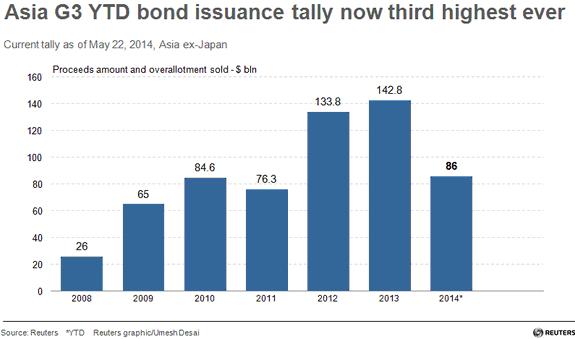
If one were to observe the Asian USD bonds, however, one would certainly believe that the good times are still rolling on. New bonds worth USD 80 bn have been issued in the first five months of 2014, at par with the corresponding period of last year. (Note that the chart below includes EUR and JPY as well).
Picture
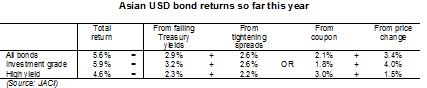
Asian USD bonds have so far produced a total return of 5.6% (see table below), split roughly equally between the returns from the falling US Treasury yields and the tightening spreads. Split another way, coupons have generated about 2% so far, while rising bond prices (both due to US Treasury and spreads) have produced 3.4%. The table below shows that investment-grade has outperformed high-yield so far. This is mainly thanks to the concerns over the Chinese property credits and the impact of the falling coal prices on Indonesian mining credits.
Click to expand image
This total return looks quite respectable when viewed against the overall equity market performance. MSCI Asia ex-Japan equity index is up 2.8% this year, thanks mainly to emerging markets such as India. Hang Seng, on the other hand, is flat.

Regular readers of this blog may remember our recommendation for this year to overweight high-yield. We still expect high-yield to outperform investment grade. While we still believe in that prognosis, investors would be well advised to follow two other broad strategies:

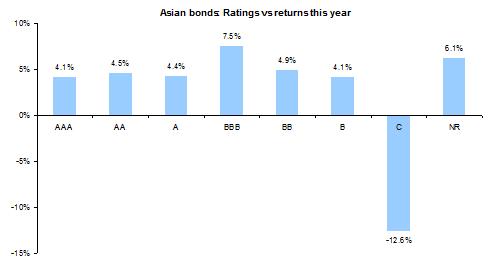
  • Stick to better quality names: While liquidity is still comfortable, there will come a day when companies with lower credit quality will find it difficult to refinance themselves. Already, bonds with lower ratings have underperformed: as the chart below shows, the best returns have come from “BBB” bonds, while the worst have come from “B” and “C” rated bonds.
Click to expand image
  • Control the duration: While the decline in the interest rates have taken many people by surprise, thereby enabling the longer-duration paper to do well, it is difficult to conceive of the rates falling further. In fact, discussions have already started in the Fed about when the first rate increase should take place. At this juncture, it is better to shorten the maturity of the portfolio towards five years rather than longer. Many perpetual bonds look increasingly riskier, unless the issuer has a strong incentive to call the bonds earlier.
0 Comments

CNH bonds: Holding steady despite the currency volatility

3/25/2014

0 Comments

 
In its short six-year life, the offshore Renminbi bond market in Hong Kong, also called ‘Dim Sum’ or ‘CNH’ bonds, has emerged as an investors’ favorite. A range of issuers, including the Chinese government, Chinese banks and companies and foreign companies, have issued debt in this market, raising the total outstanding value to over RMB300bn for bonds and another RMB250bn for certificates of deposit.

From the investors’ point of view, CNH bonds were attractive because their total return came from not only the underlying bond yield, but also the expected appreciation of the Renminbi. In addition, CNH bonds were less volatile than Asian USD bonds, although less liquid too. Some investors felt they could park their money in CNH and enjoy a steady and superior return.

Investors’ expectations were validated as the Renminbi had climbed steadily at an annual rate of 3.4% against the dollar from August 2010 until January 2014, after being frozen from 2008 to 2010 during the peak of the financial crisis.

But recent developments have shaken the expectations. Since January 2014, in just over 60 days, the Chinese currency has weakened 2.8%. On March 15, the People’s Bank of China widened its daily trading band to 2% around the central value from the previous 1%, raising the possibility of further depreciation in the currency. Whether the currency falls further or not, these changes have raised the volatility of the currency.

The reasons for the currency fall are not far to find. The Chinese economy has been slowing perceptibly over the last two quarters. There are rising concerns over the significant amount of credit creation in the economy. These concerns have led to the exit of some hot money from the currency. There is also the possibility that the currency depreciation may actually be welcomed by the Chinese authorities in the face of slowing exports from China.

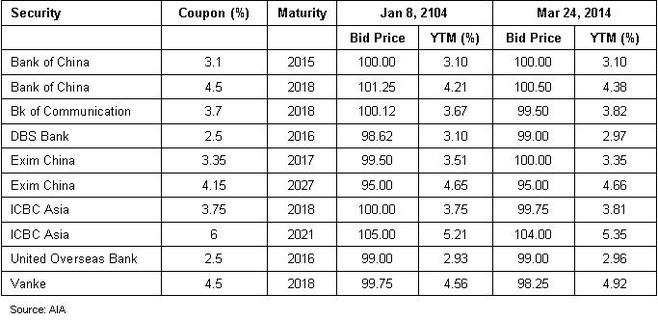
Whatever the reasons, the currency fall has shaken one significant support to the CNH bond market. But the surprising fact is that the CNH bond values have hardly budged in the last two months (see table below). Reflecting that, the HSBC CNH index has held steady from 107.45 at the beginning of the year to 107.81 on March 21. One reason could be that investors, particularly the private-bank investors, view the currency weakness as temporary.
Picture
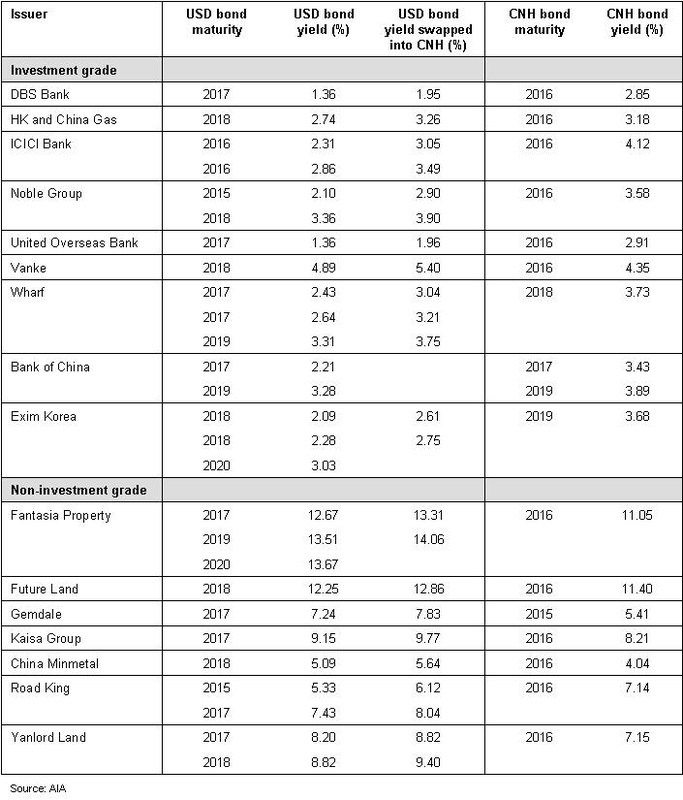
Is the CNH market still attractive for investments, despite the currency moves? To answer that question, we have compared several names that have issued in both the CNH and USD bond markets (see table below). It is evident that, for several investment-grade Asian names, CNH bonds offer higher yields for the same or shorter maturities. Even after accounting for the cost of hedging the currency exposure, the CNH market offers a pick-up of 50 to 100 basis points over the USD market. However, for non-investment-grade names, the USD market offers better yields.
Picture
It is clear that the CNH market has not lost its allure for investors even after the recent currency gyrations. It will take much more than a couple of months of currency weakness to shake their faith.
0 Comments

Explaining Asia's growth (Book review)

3/9/2014

0 Comments

 
Within Asia, the north-eastern countries (Japan, Korea and Taiwan) have progressed much faster in the last 50 years than the south-eastern countries (Indonesia, Philippines, Thailand and Malaysia).

Would you believe that, in 1950, Philippines was richer than Korea and Taiwan? Or that there was hardly any difference between Taiwan, Korea, Indonesia and Thailand? Or that China was lagging Indonesia and Philippines? Here are their GDP per capita figures for 1950: Japan $1,873, Philippines $1,293, Taiwan $922, Korea $876, Indonesia $874, Thailand $848, China $614, India $597*. Today, Japan, Korea and Taiwan have all ascended to the developed country status, while Indonesia, Philippines and Thailand have been left behind. The question is why.

In his latest book, "How Asia Works", Joe Studwell tries to answer that question. He identifies a magic formula with three ingredients: land reforms; state-supported manufacturing development; and state-controlled  financial sector being harnessed to support manufacturing.

The first one, land reforms, consists of restructuring agriculture  into labor-intensive household farming, which maximizes agricultural productivity by making use of the excess labor available in the initial stages of development. This results in a surplus that creates demand for goods and services and sets the stage for the second initiative, development of state-supported manufacturing.

State-supported manufacturing means channeling investment towards manufacturing rather than other types of businesses. This creates productive jobs for workers with limited skills as they migrate out of agriculture. For this process to be successful, Studwell lays down two essential conditions: rapid learning of advanced manufacturing technologies and subjecting manufacturing to export discipline to make sure that only the globally competitive industries survive.

The third intervention is to control and harness the financial sector to provide the necessary capital for the agricultural and manufacturing development, rather than other types of businesses, including services and personal consumption. The financial sector could also be used as a tool to ensure export discipline for the manufacturing industries.

Well, that's it - the magic formula. Having explained this right upfront in the foreword, Studwell spends the rest of the book mainly presenting the historical evidence for his theory. Much of his evidence is anecdotal and historical; not much of statistical tables and charts, but a lot of narrative economic history. In between, the narrative is interspersed with his observations from his travels in some of the countries, in so far as they are related to his theory.

In general economic commentaries, we do not generally read much about state-directed manufacturing and finance as elements critical to economic development. Hence Studwell’s theory is an interesting one. But I could not help questioning it as I read along.

One issue is whether these historical lessons are still relevant. In other words, can the lesser-developed countries start implementing this formula today and achieve development? For instance, it can be argued that what is holding back India are misdirected and wasted subsidies, corrupt and inefficient bureaucracy and the plutocratic political class. For India, the solution has to start with dismantling the current economic and political structures rather than more state-directed support for selected manufacturing industries or state-directed lending for farming and manufacturing.

In many places, the book comes across like extolling central planning and state control. Studwell praises the economic model followed by Park Chung-hee, Korean dictator from 1961 until his assassination in 1979. It so happened that Park’s economic policies contained some of the positive elements such as manufacturing development, rapid technological acquisition and development of globally competitive industries, which helped Korea’s fast economic development. But central planning and government control over the economy can easily turn into crony capitalism, as it happened in Indonesia’s Suharto period or in India until the economic liberalization of 1991. Russia is another ongoing example of how state control has not managed to lay the foundations for sustained economic performance – the country remains sorely dependent on oil and gas revenues. The point is that, for every one successful state-directed economic development, there are myriad examples of misdirected, corrupt and failed attempts of state-directed economy.

It is not clear to what extent Studwell’s model applies to China’s incredible rise in the last four decades. While China has followed the export-led growth model and turned itself into the world’s factory, it has yet to prove its ability to acquire and develop advanced technologies. Although Studwell provides some figures about the growth in the total profits earned by state-owned firms, there is a lot of other evidence that their return on capital invested is much lower than that achieved by private firms. It is then no wonder that China's incremental capital-output ratio has been rising. China today stands at a crossroads, when it needs to shift from export-and-investment-led growth to domestic-and-consumption-led growth.

A good question may be worth more than one good answer. As such, books should not be judged solely by their ability to provide answers. In that sense, Studwell’s book provokes many interesting questions. For example, how is India going to achieve economic prosperity and provide jobs to its expanding young population without developing its manufacturing sector? Its vaunted information technology sector has created 3m direct jobs, hardly enough to scratch the surface, leave alone making a dent in the country’s employment levels. While Indonesia has ridden the commodity boom for the last 10 years, how is it going to climb further without a coherent competitive strategy? Malaysia has got stuck in the middle-income trap without a clear strategy of how to develop further.

As Studwell points out, the economic profession seems to have adopted the mantra of free market, the government’s role being only to build the infrastructure, provide the legal and institutional framework and set the monetary policy, leaving the manufacturing and services sectors to decide their growth strategies. This book raises interesting questions about whether governments should legitimately play a more interventionist role in fostering development.

I had immensely enjoyed Studwell’s earlier book, “Asian Godfathers”. It was a riot of a read about Asia’s business tycoons and their escapades, although with a solid message about how they had cornered the economic systems to their own advantage. “How Asia Works”, on the other hand, is much more of a slow and difficult read.

* "All countries compared for Economy> GDP per capita in 1950, Angus Maddison. Aggregates compiled by NationMaster." 1950.
<http://www.nationmaster.com/country-info/stats/Economy/GDP-per-capita-in-1950>.
0 Comments

Asian credit strategy in 2014: A tale of two interest rates

1/12/2014

4 Comments

 
Asian dollar bonds ended in the red last year with a total return of -1.3% according to the JP Morgan Asia Credit Index (JACI). However, this figure masks a large variation between different segments. At the low end, investment-grade sovereigns lost 8.2%, while at the high end, high-yield corporates produced a return of 4.3%. Within high-yield corporates, Chinese property credits were the best performers, earning a return of over 7%.

The negative return was mainly due to the pick-up in Treasury yields, particularly after May 2013 when talk of tapering emerged. Spreads on Asian bonds performed well, with the overall spreads steady at 260bp despite the ructions in market.

The outlook for 2014 will again be dependent on both Treasury yields and the underlying credit fundamentals. With the Fed poised to taper the quantitative easing over the course of the year, and as the US economy continues to accelerate, we can expect further increases in Treasury yields. After the 10-year Treasury yields have already touched 3%, they are unlikely to rise at the same pace as last year, and a rate in the mid-3% area for 10 years seems appropriate for the end of 2014.

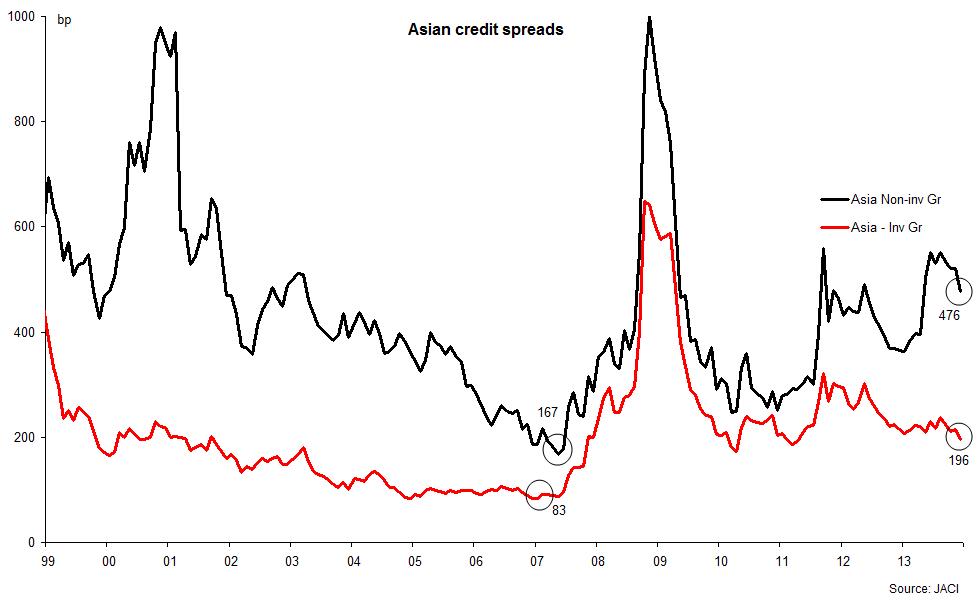
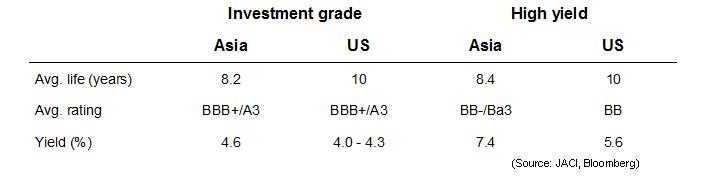
Asian spreads are still higher than their pre-crisis levels (see chart below). In addition, the table below shows that Asian dollar bonds provide a yield pick-up over US bonds for same/higher ratings and shorter maturities. The yield pick-up is about 30-60bp for investment-grade and about 180bp for high-yield bonds. Given these factors, there is scope for a further contraction in Asian spreads by 25-50bp. This should cushion the impact of the expected rise in Treasury yields.
Click to enlarge
Click to enlarge
The other supporting factors for spreads are the likely low default rates and steady credit ratings in Asia. The underlying economic picture should also be supportive for credit quality – the US economy is likely to further pick up this year, Europe is expected to limp back to stability after recession, and Asia should be supported by the improving external economic environment.

If Treasury yields rise and spreads contract, the net effect could still lead to a positive return for Asian credits as a whole. The average yield on Asian bonds is 5.3%, composed of 4.6% for investment grade and 7.5% for high yield, according to JACI. As long as Treasury yields do not rise steeply, the overall return should be close to the yield. Of course, the net return depends on the extent to which Treasury yields rise.

For instance, if 10-year Treasury yields reach 3.5% and spreads contract 25-50bp, then the total return could reach close to 4%.

With the Asian credit universe, high-yield corporates are once again set to outperform investment-grade credits. High-yield bonds should do well as long as default rates stay low and the refinancing environment remains comfortable. Hence it makes sense to overweight high-yield bonds in Asia.

That brings us to the concept of the two interest rates: one that applies to the investments and the other to leveraging the portfolio. Over the course of this year, as the Fed tries to taper down its quantitative easing, longer-term interest rates are set to rise further, negatively affecting the market values of bonds. Hence, it is important for investors to focus their portfolios towards the short-to-medium-term maturities of, say, around 5-7 years.

The short-term interest rates, on the other hand, are likely to stay low, as the Fed will continue to keep the short-term rates close to zero for an extended period of time, perhaps until the end of 2015, and raise the rates only in small steps after that. Investors can use this to leverage their portfolios by borrowing short-term funds.

There is one final element in the construction of the portfolio strategy in Asian credit, and that is to choose credits carefully with regards to their fundamentals. While the refinancing environment may be reasonably easy in 2014, the same cannot be said of the years after that. As liquidity tightens in 2015 and as cost of funds rise, not all the borrowers will find it easy to refinance maturing debt. That in turn could lead to mark-to-market losses for weaker credits, perhaps later in 2014 or beyond. Investors must position their portfolios by carefully avoiding such weaker credits.

So, let’s put together the main elements of the suggested investment strategy in Asian credits:
  1. Keep the portfolio maturity towards the lower end, i.e., 5-7 years.
  2. Continue to employ leverage to improve returns.
  3. Overweight high-yield over investment-grade.
  4. Choose the credits carefully and avoid fundamentally weaker credits, even if their yield is attractive.

By carefully managing the portfolio, it is possible to generate returns of up to 8-10% from Asian dollar bonds for 2014. 

4 Comments

Tapering and the future for fixed-income markets

11/17/2013

1 Comment

 
Last week, I participated in three panel discussions in the South East Asia Borrowers and Investors Forum in Singapore. In my panels and throughout the conference, one word kept reverberating: “Tapering.” Unknown and unused in the financial markets previously, the word has acquired a magical significance ever since Bernanke uttered it in May.

The fear of tapering took a slightly different form in the context of local-currency bonds as opposed to USD bonds from Asia. In case of USD bonds, the question was the potential for fixed income as an asset class to produce returns in the face of rising rates; in case of local-currency bonds, the issue was linked to the potential for fund outflows from emerging-market economies, triggering volatility in currencies, equities and bonds alike.

Over the next few months, there are many flash points for emerging markets, including India, Indonesia and Brazil. The first is the next round of negotiations in the US for the debt ceiling in January. Then comes the potential beginning of tapering by the Yellen Fed, some time in the first quarter. After that, the national elections in India (before May 2014), the presidential elections in Indonesia (July 2014) and the general elections in Brazil (October 2014). Each of these events has the potential to keep alive the volatility that we have witnessed this year.

The current mood in the fixed-income markets is one of relief (that the tapering is not imminent) mixed with foreboding (that rates are eventually set to rise further). At the moment, the market is still in a healthy state, as evidenced by the flow of new issues and the stability in credit spreads.

Beyond the next few months, the shape of the fixed-income markets will depend on the speed with which interest rates normalize. I believe that even when tapering gets underway, it will be a carefully managed process by the Fed. The Fed has made it abundantly clear that any withdrawal of monetary stimulus will be data-dependent. The Fed has a lot of leeway in deciding the speed of tapering. While it may start with a reduction in QE of USD 10 billion a month, it may not continue to taper at a rapid pace if the economy begins to falter. The Fed will also be watching the behavior of long-term rates, both as an indication of the market reaction, and more importantly, as a key variable that could affect the mortgage rates and the housing recovery.

As a result of this carefully managed process of tapering, fixed income investors should be able to adjust their portfolios over the medium term. If there is a sudden jolt to the rates, like it happened during May-June 2013, leading to losses in the portfolio, there is likely to be a temporary pullback. If rates adjust gradually, over the next 2-3 years, there will be enough breathing space for investors to realize their maturing investments and reinvest them at higher yields, and thereby adjust their portfolios for rising rates.
1 Comment

Asian bonds: Steaming ahead

10/16/2013

2 Comments

 
Over the course of 2013, many factors might have been expected to lead to a slowdown in Asian dollar bond issuance. First of all, interest rates have risen from their lows in 2012, with the yields on 10-year Treasuries higher by over 100bp. While everyone knew that interest rates had to normalize at some point, the rise in yields brought that fear to the front and center of everyone’s thinking. Then, in May, Bernanke raised the possibility of slowly withdrawing the monetary accommodation with his discussion of “tapering.” Third, for the last three weeks, we have tried to grapple with the possibility that the U.S. government may have to cut back on paying for its commitments and expenses if the debt ceiling is not raised by October 17.

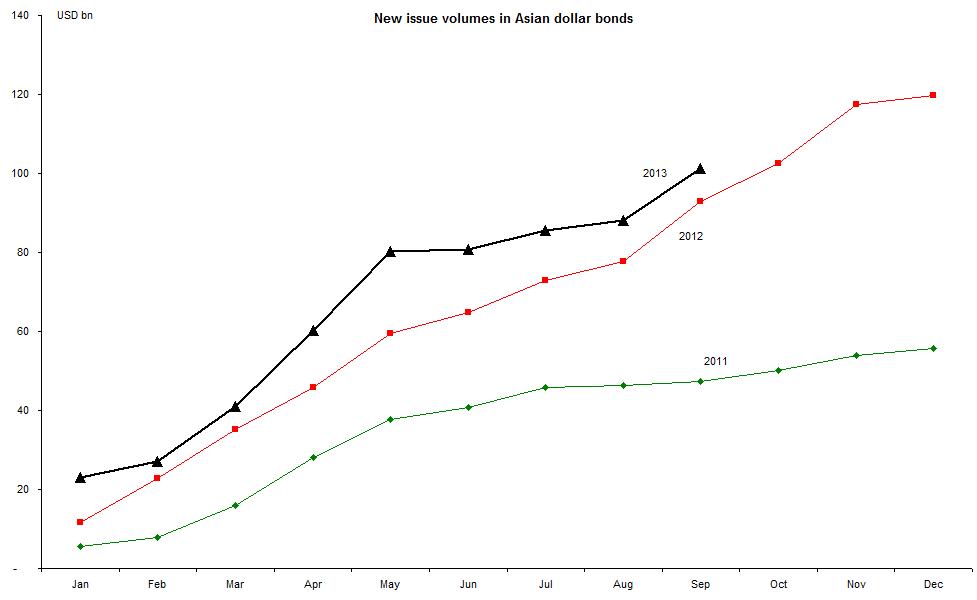
In the midst of all this, Asian bond markets have had a great year in terms of new issues. So far this year, by our count, over USD 110bn worth of dollar-denominated bonds have been issued by Asian issuers. Month after month, in terms of issue volumes, 2013 has outpaced 2012 (which itself was a record year).
Click to enlarge
It must be noted that this year’s record volumes are despite the lean period in June to August, when only USD 7bn was issued in the full three months. Although this period is usually a low season, this year’s volume was much below the USD 18bn issued during the same three months last year. 

What accounts for the robust state of this market? Are investors blithely indifferent to the ructions around them?

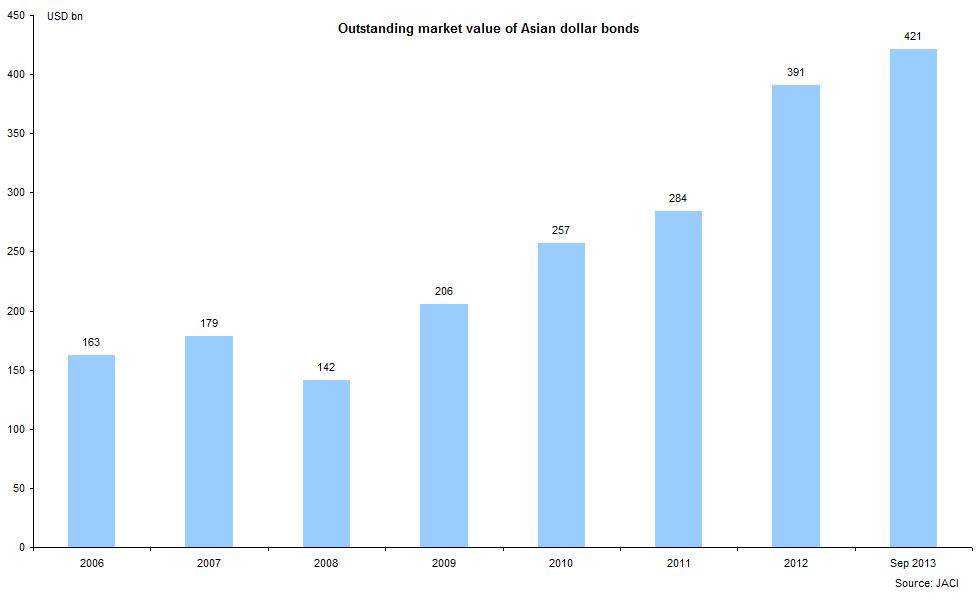
The first thing to recognize is that much of the new issues are simply replacement for maturing bonds. This becomes clear if we consider the increase in the net market value outstanding at the end of the last few years (see chart below). This year, the market value has risen by USD 30bn – not a bad number, but still a slower pace of growth.
Click to enlarge
The figures nevertheless show that net new money has been available for bond issues, despite the repeated challenges. From the issuers’ point of view, the cost of funding is still attractive. Yields of 2.6% on 10-year Treasuries are still near the multi-decade lows, and the bond spreads are also reasonable although higher than the pre-crisis levels. From the investors’ point of view, Asian dollar bonds still offer a pick-up over comparable US domestic issues, even among investment-grade bonds. 

At this stage, it is fair to say that Asian dollar bonds have become a legitimate, large asset class with a diversified pool of issuers and sufficient liquidity for investors. Asian dollar bonds represent roughly 40% of all emerging market dollar bonds. Even as interest rates continue their upward journey in the medium term, we believe that institutional money would still be actively engaged in this market.
2 Comments

Asian bonds: Rising discrimination

10/16/2013

0 Comments

 
This is a reproduction of an article in Reuters published on September 11, 2013.
Ever since reports emerged that the United States might taper off its bond-buying program, emerging markets have whipsawed: falling currencies, rising rates and fleeing funds. India and Indonesia have been two of the most affected countries in Asia.

The Asian dollar bond markets have also been affected by the fear of tapering. On the one side, longer-term bonds have lost substantial value as U.S. interest rates have picked up. Additionally, investors have discriminated between bonds from vulnerable countries and those from stronger countries.

In India’s case, state-linked entities such as banks and oil companies have issued most of the bonds. Since May 22, when the word “tapering” burst into financial markets, the Indian rupee has plunged by 23 percent. At the same time, spreads for Indian dollar bonds widened by as much as 130 basis points, even for five-year bonds. The spreads on the benchmark 2018 bond from State Bank of India widened by 120 basis points from end-May until end-August.

There were many underlying fears that led to this. One was a potential downgrade of India’s rating, currently at its lowest investment-grade level. Standard & Poor’s, in particular, has a negative outlook on its rating, and has remarked that there is a one-third chance of a downgrade in the next one to two years, which may well be accelerated if things do not improve. The other fears are rising inflation, a slowdown in growth and the consequent deterioration of business fundamentals.

For Indonesia, the currency depreciation during the same period was 16 percent; but the 2018 and 2023 Indonesian sovereign dollar bond spreads widened by 140-150 basis points. This is despite the fact that Indonesia took some strong steps to control the situation, including raising petrol prices by 44 percent and diesel prices by 22 percent in June, and raising interest rates by 125 basis points.

During the same period, the spreads on dollar bonds issued from stronger countries have hardly widened. For instance, from Hong Kong, Hutchison’s 2019 bond spreads are up by only 10 basis points; from Singapore, Temasek’s 2023 bond’s spreads have not changed; from Korea, the 2019 sovereign bond’s spreads have risen by only 5 basis points.

Chinese dollar bonds present a different story. Their performance has been driven more by evolving views on Chinese growth, rather than U.S. Fed tapering fears. While bonds from cyclical sectors, such as Cement and Steel, have widened by 50-150 basis points, those from property companies have held well (for instance, the benchmark Country Garden 2018 bond has actually compressed by 40 basis points in terms of spreads).

The overall picture in the Asian dollar bond market, then, is one of rising discrimination between bonds from weaker and stronger economies. Similarly, even within the same country, bonds that are more vulnerable to economic slowdown have underperformed. For instance, in India, bonds issued by private-sector banks and companies have outperformed those from state-linked banks and companies.

In a way, this is a testament to the market’s ability to distinguish specific kinds of credit in terms of their strengths and weaknesses, rather than lumping all of them into an “emerging market” bucket.

As we look ahead, one key question is whether potential tapering has been fully priced in to the Asian bond markets. While U.S. 10-year rates have gone up by more than 120 basis points, many emerging-market currencies and equities have slid, and bond spreads have risen, there is still likely to be a residual effect which will kick in once the tapering plans are confirmed and the actual tapering begins. When that happens, the discrimination between credits in Asia will only strengthen.

In that sense, India and Indonesia cannot rest easy yet. Their struggles with currency, inflation and their balance of payments are likely to spill over into their dollar bonds too, taking their spreads higher as and when tapering begins in  earnest.

At some point, though, some investors will find value in these bonds. There is some evidence that Indian spreads reflect about 60 to 70 percent of the impact of a rating downgrade. If that number inches towards 80 to 90 percent, that would be a good time to buy those bonds.
0 Comments

The evolving role of fixed-income investments in Asia

10/16/2013

0 Comments

 
Asian fixed-income markets have undergone a sea change in the last five years. The market value of outstanding USD bonds from Asia ex-Japan issuers has soared from USD160bn in 2008 to USD420bn currently.

This dramatic growth is the result of the confluence of many factors. Investors were happy to absorb increasing volumes of bonds as their portfolio values kept rising because of falling interest rates as well as tightening spreads driven by the search for yield. Particularly in Asia, private-wealth investors piled into debt investments, raising their participation in new issues from 1%-4% during 2004 to 2008 to a high of 16% in 2012. Issuers were happy to supply the market, as they benefited from lower cost of funds from falling interest rates and tightening spreads, and as they sought to replace bank loans with bond issues.

But now, there is fear in the fixed-income land. As the Fed began to talk of “tapering” its QE3 purchases of government securities, 10-year Treasury rates have flared up by 100bp in a short period of eight weeks. Not only that, but people have begun to realize that interest rates are due for a continual rise in the 12-24 month horizon. In Asia, new bond issues have slowed to a trickle; the frequent flow of new issues stopped on May 22, followed by just two issues in the last seven weeks.
 
If indeed interest rates are set to rise continually, and the best days of fixed-income investing are past, then what does the future hold for Asian fixed income?
 
First of all, Asian investors will need to start appreciating the different roles that fixed income can play in their portfolios. One is capital preservation. While Asian investors have got used to capital appreciation from their fixed-income portfolios, they will need to start viewing them as instruments for capital preservation.

The other role of fixed income is to provide stability; in other words, bonds have a lower beta than equity and are less volatile. If equity markets correct by 20%-40%, bonds will not be completely immune, but would drop by a lower percentage (unless they are highly speculative bonds issued by companies on the verge of default).

Another role of fixed income is to produce stable income. Although it is possible to invest in high-dividend equity, the exit value from the investment is still uncertain; but in case of bonds, investors know the income and the maturity value of the investment (barring default).

The coming period of 2-3 years will be the most challenging for fixed-income: as interest rates rise in response to the improving economic picture in the US, existing bond portfolios are bound to show a mark-to-market loss. But once interest rates reach a higher level with some stability, fixed-income investments will be available at higher yields, making them attractive to Asian investors once again, not for capital appreciation, but as instruments for capital preservation and income generation.
0 Comments
<<Previous
Forward>>

    RSS Feed

    Author

    Dilip Parameswaran
    Twitter: @AsianCredit

    Archives

    September 2019
    January 2019
    May 2018
    January 2017
    September 2016
    May 2016
    January 2016
    November 2015
    August 2015
    June 2015
    March 2015
    February 2015
    January 2015
    November 2014
    October 2014
    September 2014
    June 2014
    March 2014
    January 2014
    November 2013
    October 2013

    Categories

    All
    Asia
    Asian Hard Currency Bonds
    Asian Hard Currency Bonds
    Bonds
    Books
    China
    CNH
    Economics
    Equity
    High Yield Bonds
    High Yield Bonds
    India
    Trade
    USA

    Recent Posts

    FeedWind
Powered by Create your own unique website with customizable templates.